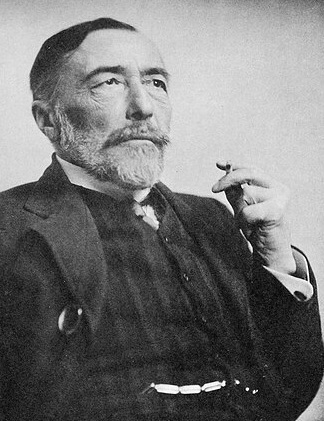
Joseph Conrad
Joseph Conrad (1857–1924), born Józef Teodor Konrad Korzeniowski, was a Polish-born British novelist and master of English prose. Born on December 3, 1857, in Berdychiv, in the Russian Empire, Conrad learned English as an adult and went on to become one of the most influential writers in the English literary tradition. His works are known for their psychological depth, atmospheric settings, complex narratives, and exploration of colonialism, morality, isolation, and the darker aspects of human nature.
Conrad spent many years at sea and worked as a merchant marine officer before becoming a full-time writer. His experiences aboard ships and his journeys through Asia, Africa, and other regions provided important inspiration for his fiction. His maritime background allowed him to create vivid descriptions of the sea while examining the moral and psychological challenges faced by individuals in unfamiliar and dangerous environments.
Among Joseph Conrad's most famous works are Heart of Darkness, Lord Jim, Nostromo, and The Secret Agent. Heart of Darkness, published in book form in 1902, follows the narrator Marlow as he travels into the African interior in search of the enigmatic Kurtz. The novella explores imperialism, violence, moral corruption, and the fragile boundary between civilization and savagery.
Conrad's fiction is particularly notable for its sophisticated narrative techniques. He frequently used framed narratives, shifting perspectives, unreliable narrators, and symbolism to reveal the inner conflicts of his characters. His prose can be challenging and layered, inviting readers to interpret events rather than providing simple explanations. His work also influenced the development of modernist literature and later psychological fiction.
Joseph Conrad died on August 3, 1924, in Bishopsbourne, Kent, England, at the age of 66. Despite learning English later in life, he became one of its most respected literary stylists. Today, Joseph Conrad is regarded as a major figure in English literature, particularly for his powerful examination of imperialism, human psychology, moral ambiguity, isolation, and the complexities of the human condition.